
ON CHARTS, EGO AND FORM
I have always been attracted to natal charts.
Not because they promise a future — I don’t believe they do — but because they feel like a fingerprint. Not of me, but of the sky at the moment I appeared. A registration. A configuration.
What interests me is not prediction, but structure.
There is something quietly reassuring in knowing that my presence can be described as a geometry: planets, angles, houses. Not as a story, but as a system.
Maybe this is my hidden form of protagonism: not being seen, but being positioned.
When I asked how many people in the world share my exact natal chart, the answer was simple and unsettling: statistically, almost no one. Possibly no one.
Not because I am special, but because the configuration itself is irreproducible. Like a diagram that happens once and never again.
This made sense to me.
It felt close to the way I work.
We talked about algorithms, about the difference between calculation and interpretation. About how a chart can be mathematically precise and conceptually shallow at the same time.
What stayed with me was the idea that the chart is strong where it measures, and weak where it explains.
Then we moved somewhere else.
I shared one of my works: EGO LXI.

A face, stripped of gaze, flushed, exposed. Not a portrait, but an instance. An ego without history, without costume, without protection.
Reading it as if it were a natal chart made something click.
The eyes crossed out not as provocation, but as refusal of exchange.
The red as physiology, not emotion.
The symbols above the head not as guidance, but as noise — planets no longer governing, only orbiting.
It wasn’t about identity.
It was about pressure.
Then I placed EGO LXI next to a Medici portrait.
Caterina.
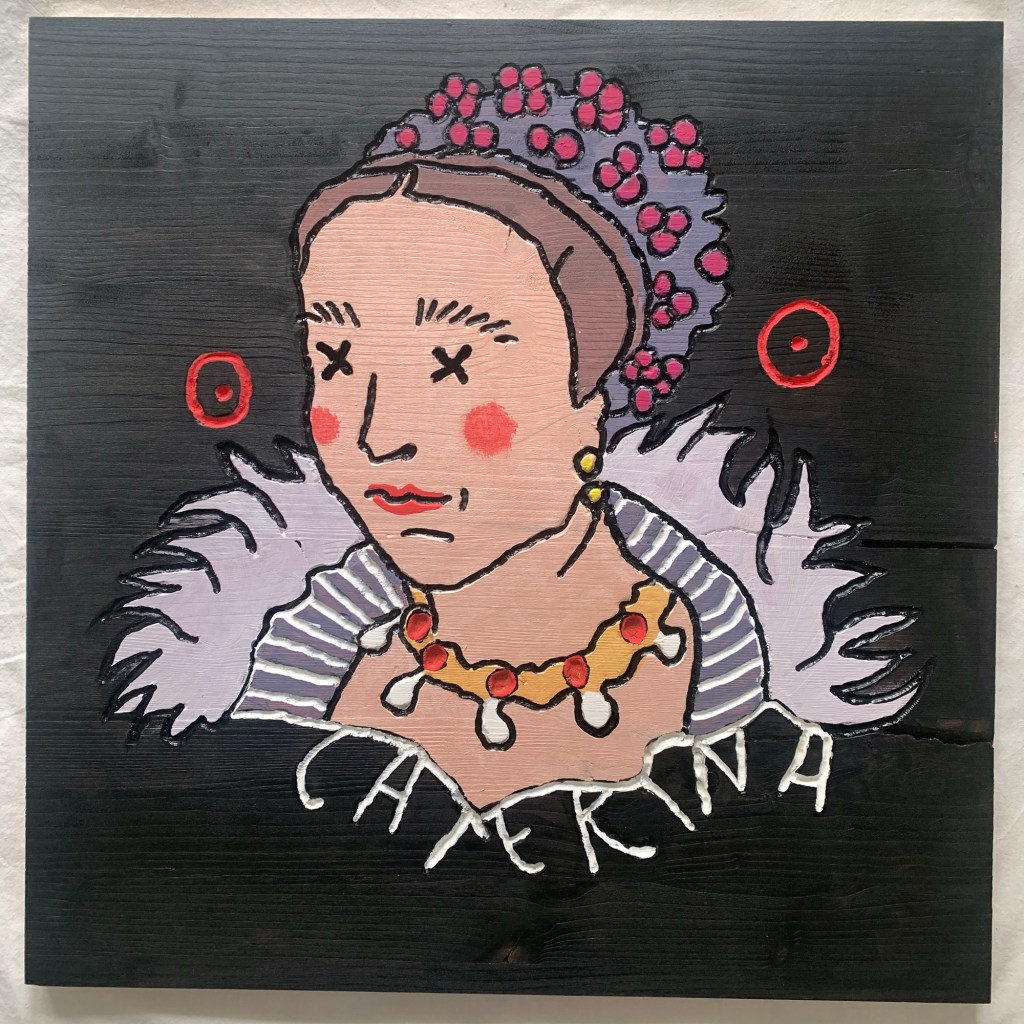
Same system. Same language.
Different time.
In EGO LXI, the ego is naked, reactive, unstable.
In Caterina, the ego is armored, ritualized, architectural.
One is before legitimacy, the other after victory.
What changed was not the structure, but time.
This was the moment I understood something clearly:
I am not interested in individuals.
I am interested in the form of the ego across time.
We reversed the process.
My natal chart translated into an XXY portrait: reduced, contained, structural.
No name, only series.
A face that doesn’t ask to be seen, but to function.
Then EGO LXI translated into a sky:
a strong Sun without support, a frontal Ascendant, a restless body, a missing Saturn.
An ego visible before it knows why it exists.
Two configurations.
Two responses to the same historical problem:
how to stand at the center without being consumed by visibility.
I realized that what I do is not representation.
It is containment.
I don’t celebrate ego.
I don’t criticize it.
I give it a form precise enough to be measured.
Maybe this is why natal charts resonate with me.
They don’t flatter.
They don’t explain.
They place you.
And that, for me, is enough.
 saulzanolari.com